

Home |
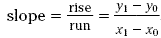
Writing Linear Equations in Standard FormFinding an Equation for a Line Passing Through Two PointsTwo points determine a line and that there is exactly one line that goes through any two distinct points. This can also be illustrated using a ruler, and showing that if two points are specified, then the ruler can only be placed over them in one way. Now, draw two points (with coordinates), say A (1, 5) and B (3, 11). What information do we need to write an equation describing the line going through A and B ? The slope and a single point on the line. We already have a point; we can choose either A or B. To find the slope, we use the formula. When we compute slope using two points ( x 0 , y 0 ) and ( x 1 , y 1 ), the formula is
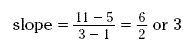
In our case, this gives
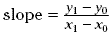
We now know that the slope of the line through A and B is 3. We also know that A (1, 5) is a point on the line. So, when we substitute into the point-slope formula, we use m = 3, x 0 = 1, and y 0 = 5. This gives us the following equation that describes the line. ( y - 5) = 3( x - 1) Here are some more exercises. Exercises 1. Write an equation in point-slope form that describes the line through the points (2, 7) and (5, 16). ( y - 7) = 3( x - 2) or ( y - 16) = 3( x - 5) 2. Write an equation in point-slope form that describes the line through the points (0, - 1) and (1, - 4). ( y + 1) = -3( x ) or ( y + 4) = -3( x - 1) There are many different equations in point-slope form that describe the same line. It is easy to write a formula for an equation describing the line including the two points ( x 0 , y 0 ) and ( x 1 , y 1 ). First, remember the formula that gives the slope of the line including two points.
The graph of this equation is the line through the two points. It is important to practice substituting into this formula. You could redo Exercises 1-2 using this formula.
Standard FormThis is a different form for the equation describing a line. The advantage of this form is that it can be used to describe all lines, even vertical ones. The disadvantage is that it does not depend as explicitly on a point and a slope or on two points, as does the point-slope form. It is possible to manipulate the equation defining a line using the Multiplication and Addition Properties of Equality, as well as the usual rules of arithmetic, such as the Commutative, Associative, and Distributive Properties. Suppose a line is defined by ( y - 2) = 5( x - 3). Notice that the equation is the point-slope form for the line with slope 5 passing through the point (3, 2). We can make some changes using the properties from above. ( y - 2) = 5( x - 3) Distributive Property y - 2 = 5 x - 15 Add 2 to each side. y = 5 x - 13 Subtract 5x from each side. - 5 x + y = -13 5 x - y = 13 Multiply each side by -1. This last equation gives the same line as the original equation, since it is equivalent to it. We say it is in standard form because all the variables are collected on one side and all the "numbers" (constants) are collected on the other side. Here are some examples of equations that are in standard form. In each case, the variables are all on the left and the constants are all on the right 5x + 7y = 9 4x - 8y = 0 0.3x + 0.5y = 1.7 Here are some examples of equations that are not in standard form. y = 3x + 1 x + y - 4 = 1 Key Idea Any equation in point-slope form can be changed into an equivalent equation in standard form. This is done by removing all constants from the left-hand side and by removing all variables from the right. Remember that for vertical lines, the slope is undefined. This means that an equation in point-slope form cannot be written for a vertical line, since there is no slope to insert. The following examples shows that we can write an equation in standard form for a vertical line Example The vertical line through (4, 0) can be defined by the equation x = 4. Write this equation in standard form. Solution This equation is already in standard form, since there is only a variable on the left-hand side and only a constant on the right. Key Idea Any line (even vertical ones) can be described by an equation in standard form. |

 There are variables on both sides of the
equation.
There are variables on both sides of the
equation.