
Home |
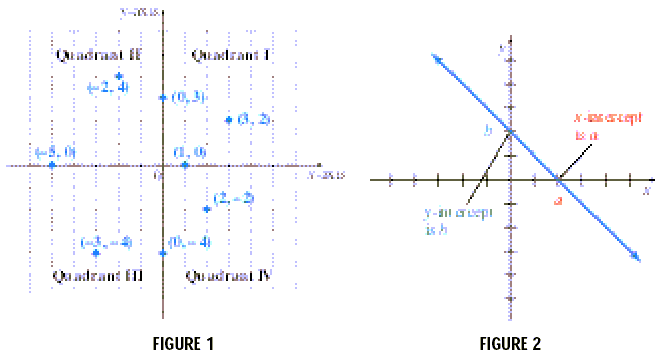
Straight LinesOrdered pairs are graphed with the perpendicular number lines of a Cartesian coordinate system, shown in Figure 1. The horizontal number line, or x -axis, represents the first components of the ordered pairs, while the vertical or y -axis represents the second components. The point where the number lines cross is the zero point on both lines; this point is called the origin. Each point on the xy-plane corresponds to an ordered pair of numbers, where the x-value is written first. From now on, we will refer to the point corresponding to the ordered pair (a, b) as “the point (a, b)”. Locate the point (-2, 4) on the coordinate system by starting at the origin and counting 2 units to the left on the horizontal axis and 4 units upward, parallel to the vertical axis. This point is shown in Figure 1, along with several other sample points. The number -2 is the x -coordinate and the number 4 is the y -coordinate of the point (-2, 4). The x-axis and y-axis divide the plane into four parts, or quadrants. For example, quadrant I includes all those points whose x- and y-coordinates are both positive. The quadrants are numbered as shown in Figure 1. The points on the axes themselves belong to no quadrant. The set of points corresponding to the ordered pairs of an equation is the graph of the equation. The x- and y-values of the points where the graph of an equation crosses the axes are called the x -intercept and y -intercept, respectively. See Figure 2.
The different forms of linear equations are summarized below. The slope-intercept and point-slope forms are equivalent ways to express the equation of a nonvertical line. The slope-intercept form is simpler for a final answer, but you may find the point-slope form easier to use when you know the slope of a line and a point through which the line passes.
Equations of Lines
|
||||||||||