

Home |
Quadratic EquationsAn equation with 2 as the highest exponent of the variableis a
quadratic equation. A quadratic equation has the form ax The simplest way to solve a quadratic equation, but one that is not always applicable, is by factoring. This method depends on the zero-factor property. ZERO-FACTOR PROPERTY If a and b are real numbers, with ab = 0 then a = 0, b = 0 or both. Solving Quadratic EquationsEXAMPLE Solve 6r Solution First write the equation in standard form. 6r Now factor 6r (3r - 1)(2r + 3) = 0 By the zero-factor property, the product (3r - 1)(2r + 3) can equal 0 if and only if 3r - 1 = 0 or 2r + 3 = 0 Solve each of these equations separately to find that the solutions are 1/3 and -3/2. Check these solutions by substituting them in the original equation. CAUTION Remember, the zero-factor property requires that the product oftwo (or more) factors be equal to zero, not some other quantity. It would beincorrect to use the zero-factor property with an equation in the form (x + 3)(x - 1) = 4 for example. If a quadratic equation cannot be solved easily by factoring, use the quadratic formula. (The derivation of the quadratic formula is given in most algebra books.) QUADRATIC FORMULA The solutions of the quadratic equation ax
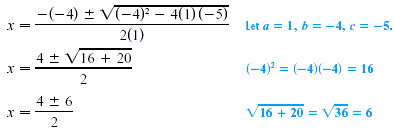
EXAMPLE Solve x Solution The equation is already in standard form (it has 0 alone on one side of the equals sign), so the values of a, b, and c from the quadratic formula are easily identified. The coefficient of the squared term gives the value of a; here a = -1. Also b = -4 and c = -5 (Be careful to use the correct signs.) Substitute thesevalues into the quadratic formula.
The
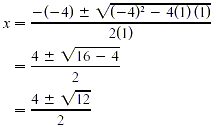
The two solutions are 5 and -1. CAUTION Notice in the quadratic formula that the square root is added to orsubtracted from the value of -b before dividing by 2a. EXAMPLE Solve x Solution First, add -4x on both sides of the equals sign in order to get the equationin standard form. x Now identify the letters a, b, and c. Here a = 1, b = -4, and c = 1. Substitute these numbers into the quadratic formula.
Simplify the solutions by writing
The two solutions are The exact values of the solutions are
NOTE Sometimes the quadratic formula will
give a result with a negative number under the radical sign, such
as *The symbol |
 +
bx + c = 0, where a, b, and c are real numbers and a
+
bx + c = 0, where a, b, and c are real numbers and a 0.
A quadratic equation written in theform is said to be in standard
form.
0.
A quadratic equation written in theform is said to be in standard
form. 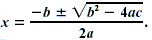
 sign represents the two solutions of the equation.
To find both of thesolutions, first use + and then use -.
sign represents the two solutions of the equation.
To find both of thesolutions, first use + and then use -.
 Substituting
  gives
gives 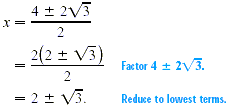

 key on a calculator gives decimal approximations of
these solutions (to the nearest thousandth):
key on a calculator gives decimal approximations of
these solutions (to the nearest thousandth):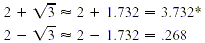
 . A solution of this type is not a real number. Since
this text deals only with real numbers, such solutions cannot be
used.
. A solution of this type is not a real number. Since
this text deals only with real numbers, such solutions cannot be
used. means “is approximately equal
to”.
means “is approximately equal
to”.