
Home |
Using Intercepts for Graphing Linear EquationsThe x-intercept of a line is the point where the line crosses the x-axis. The x-intercept has a y-coordinate of 0. Similarly, the y-intercept of a line is the point where the line crosses the y-axis. The y-intercept has an x-coordinate of 0. If a line has distinct x- and y-intercepts, then these intercepts can be used as two points that determine the location of the line. (Horizontal lines, vertical lines, and lines through the origin do not have two distinct intercepts.)
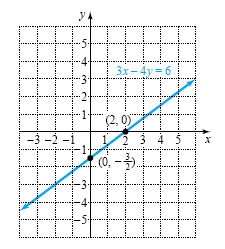
Example 1 Using intercepts to graph Use the intercepts to graph the line 3x - 4y = 6. Solution Let x = 0 in 3x - 4y = 6 to find the y-intercept:
Let y = 0 in 3x - 4y = 6 to find the x-intercept:
The y-intercept is
Caution Even though two points determine the location of a line, finding at least three points will help you to avoid errors. |
||||||||||||

 ,
and the x-intercept is (2, 0). The line through the intercepts is shown in the
figure below. To check, find another point that satisfies the equation. The
point (-2, -3) satisfies the equation and is on the line in the figure below.
,
and the x-intercept is (2, 0). The line through the intercepts is shown in the
figure below. To check, find another point that satisfies the equation. The
point (-2, -3) satisfies the equation and is on the line in the figure below.