
Home |
Solving Equations with Radicals and ExponentsRaising Each Side to a PowerIf we start with the equation x = 3 and square both sides, we get x2 = 9. The solution set to x2 = 9 is {-3, 3}; the solution set to the original equation is {3}. Squaring both sides of an equation might produce a nonequivalent equation that has more solutions than the original equation. We call these additional solutions extraneous solutions. However, any solution of the original must be among the solutions to the new equation.
Caution When you solve an equation by raising each side to a power, you must check your answers. Raising each side to an odd power will always give an equivalent equation; raising each side to an even power might not.
Example Raising each side to a power to eliminate radicals Solve the following equation:
Solution Eliminate the square root by raising each side to the power 2:
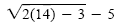
Check by evaluating x = 14 in the original equation:
The solution set is {14}. |
||||||||||||||||||||||||||